Saturday, July 17, 2010

Caladiums of the Thai Variety

This morning's post is thanks to Seigfried, who thought that I needed my face washed at 5 this morning. I really didn't need to be up that early and tried to get some more sleep, but he was just so cuddly that I gave up, and being up early with a little free time before I actually had to get up, I thought I'd finally get around to posting about the caladiums whose pictures I took over a week ago with the intention of posting them then.
We're actually getting a lot done, considering the heat and humidity. We're outside no later than 7:30 in the morning and can usually keep at it until noon, though there were a few days that we were done in by 9. We've been rather ruthlessly culling daylily seedlings to make space for some named ones that have gotten a little crowded in the beds. If you're in the neighborhood, I have some lovely clumps - some up to about 30 fans - for $5 each. (End of commercial message)
Anyway, a few weeks ago I bought 6 new caladiums from Asiatica Nursery during their going of of business sale. (Still time to order until the end of July) I just love caladiums and have perfected the keeping them alive over the winter thing, so I felt comfortable adding a few to the collection. The names are in the pots and I'm still in bed, so I'll just have to show you the pictures for this morning. They are all in Thai (?) I suppose and so not names that I remember or that just flow off the tongue.

This first one is a miniature. The leaves are less than 2 inches long and though I really like it and it is toooooo cute, I'm afraid this may be the most difficult one because the leaves are thin and delicate. All of them are living in pots on the table under the Hibiscus 'Tosca' and are starting to add new leaves. I don't ever put my caladiums in the ground for several reasons. Slugs are death to caladiums and with our wet year, they would have been gone by now. I also get busy/lazy in the fall and having to dig them up just might not happen. And last, keeping them in the pots seems to work.


This second one is far from delicate (or small). The leaves are about 10 inches long and shiny with the look of patent leather, though that doesn't show in the photo. Actually, this patterning doesn't show well unless the sun is shining through from the back. Usually they are very thick looking and dark shiny red.


These come out almost gold and pink and then change to more chartreuse.


This one is very pink and the veins are almost black and when the light hits it the right way it looks like stained glass.


I like this one with its part green and part pink leaves. There are a few where the colors are more mixed, but most are just like this.


Last is this one. More pink and green.
My tips for keeping them over the winter - neglect. I knew they had to rest, so I let them die back and then I left them in the pots. I pushed them to the back of the middle bench in the greenhouse on the east side where they would stay warm, but not have too much sun. In the spring, once it starts getting warm, I begin to water them. In a few weeks, I see sprouts and not long after the pots are full of beautiful plants again. I have two with almost white leaves - just a thin green margin, that have done so well that I'm going to have to divide them next spring.
Hopefully, I'll post again soon. I have been working on the website photos, though and will let you know when it's all done.
Jane


Friday, July 2, 2010

Daylilies in Bloom

I thought I'd just post a couple of photos of the daylilies in bloom rather than specific blossoms. This first one is taken of the bed of older daylilies behind the front barn. Most of these are introductions from the 1970s and 1980s, with a few newer ones where we've lengthened the rows. They are just gorgeous right now.
This second photo is looking from the top of the hill and actually shows 5 different sections of daylilies, but the way it looks here, it all kind of blends together.
This is the peak of bloom, a few weeks ahead of usual, but there's no putting it off, so we're just enjoying it. I hope those of you who are in the area can come over and enjoy the flowers with us. Hopefully soon I'll have some more time for writing. In addition to weeding, today I re-did (or almost finished re-doing) the garden on either side of the brick walkway leading up to the house. It had been planted about 30 some odd years ago with wild daylilies. Over the years the lilacs which are also along the walk grew and grew so that now there was so much shade that the daylilies no longer bloomed, just spread foliage all over the walk and looked kind of ratty. I decided that hostas would be much better, so I started digging out the old ditch weeds and ripping out vinca (and having Hank pull out the poison ivy) and by suppertime I had cleaned up most of it and planted 18 hostas. I probably have space for another 6 or 8 by the time I finish. I can't believe the difference this makes. Instead of looking kind of busy and frantic, it now looks cool and calm. Just amazing what 5 hours of work can make. I'll take some photos as soon as it is all done and mulched.
Enjoy the weekend and picnics and fireworks, and make time to come by and see the daylilies. We'll have the gardens open on Saturday July 3rd from 10 to 5 and on Sunday July 4th from noon to 5. Remember, all potted daylilies are still just $5 each.
Jane

Thursday, June 24, 2010

Hollyhocks

I always loved hollyhocks, but every time I bought some (forget seeds - absolutely no luck with those)they would live for a year and then not come back. In all fairness to my gardening ability, I think some little bug gets in and eats the seeds to keep them from self seeding a lot of the time because when I've tried to save seeds, there is nothing there but some husks. Anyway, about 10 years ago I decided to try again and got a red/rose colored one from Glasshouse Works. I believe it was one that originally came from Ken's parents' farm. Well, it grew and came back and there were always a few. Never a huge amount, so I still think most of the seeds are being eaten. After a few years, there was some variation on the colors, but still all in the rose/red range. This year, for unknown reasons, I have lots of hollyhocks and the color range is wonderful. Here are the eight different ones that are blooming this morning. Some are not really good pictures, but it is really hot out there and these, of course, grow in full sun, so it was a quick trip to get some pictures for the blog and then back inside to my fan.

This first one is probably close to the color of the original plant.

And this one has a texture like a tree peony, rather crepe-papery and translucent.
This is a much darker and clearer red.


This one is perfectly round, no ruffles or anything.

This is a tinier flower with a pretty eye.


This is my favorite. The petals are thin, fringed, and the center eye, though it looks cream colored here, is really a light green. Quite stunning. All of these plants are taller than I am, so there are a lot of flowers on each one. I do hope they seed around a lot. Can't wait to see what shows up next year.

This is a very, very pale pink with a slightly darker eye.

And last, another mostly round one with an edge that is green when it first comes out and then fades to cream. The bumble bees seem to like them a lot!


Hollyhocks like full sun and seem tolerant of pretty much any soil, though I don't think they like wet feet.
Stay cool,
Jane


Wednesday, June 23, 2010

"Hot" Daylilies

On such a hot day I should probably be taking pictures of cool white daylilies, but the most striking one this morning were the hot colors, the reds and oranges.

This first is one of my all time favorites 'Primal Scream' . It is a rather larger flower and right now the plant is just covered with blooms.

Next is 'Open Hearth', an oldie with a rather flat form.

'Old Tangiers' is a lovely deep orange. It always reminds me of a gorgeous sunset.

'Chinese New Year' is very similar, but leans more to the red side.

'Aztec Firebird' is a spidery/unusual form bi-color with red petals and yellow sepals. It has been a fast increaser and dependable bloomer in the 3 years it has been in the garden.


'All American Chief' is definitely red. No shades of anything else. Just red. And that's a good thing!


'Mauna Loa' has always been one of my favorites. We have clumps in several different places in the yard, and every year without exception, the first bloom on each clump will open on the same day. Odd.

'Dragon Wings' is another red. You can't really see it on the photo, but this one is really velvety looking in person. This one is a bit slower to increase, but lovely none the less.

Last for today is 'Christmas Ribbon'. This one has formed a large clump, but I have had trouble with the blooms being a bit splotchy. This year with all of the moisture and heat it is just wonderful. In addition to being very red, it is also a very large bloom, probably 10 inches across. You can pick it out from across the yard.

Not sure just what I'm going to write about next, but I'm taking pictures every day, so I'm sure something will strike my fancy tomorrow morning.
Stay cool,
Jane


Monday, June 21, 2010

More Pink

This is a new shrub we got this spring. It is Hydrangea arborescens 'Spirit'. It is a pink version of Annabelle. If you are familiar with Annabelle, you will know that is absolutely dependable with its big white flower heads that can be dried for winter. Our plant arrived quite tiny, maybe 8 inches tall. We kept it potted for the first week or two because we were still expecting frost. It has been in the ground for a month or so now and is about 2 feet tall and has 2 blooms. I really wasn't expecting our little plant to bloom this year. I think I'm going to like this one. It likes light shade, but otherwise isn't really particular. A portion of the purchase price of each plant goes to fund breast cancer research. Beautiful flower, good cause ... can't get much better than that.
Jane

Saturday, June 19, 2010

Daylilies - Mostly Pink

It's been a busy week. All this wonderful rain has made the weeds grow as well as the plants, better actually. We get up extra early to get some weeding done before the sun hits and the temperature climbs towards 90 degrees. Once it gets that hot, we either move to a weeding project in the shade, or find some other chore to do. With a garden this large, there is always something to do.
We are fast approaching the peak of our daylily season. Hard to believe since we're at least 2 or 3 weeks ahead of normal. I expect that by next weekend the show will be spectacular. So far (keep your fingers crossed) the Milorganite has been doing its job keeping the deer from eating the daylily buds. We had a tiny bit of nipping, I spread the Milorganite and since then I haven't seen any damage. So, if you're in the area, please come a visit on one of the next 2 weekends to just enjoy the flowers. All of our potted daylilies are only $5, regardless of the regular price, so it's easy to take some home to enjoy too.
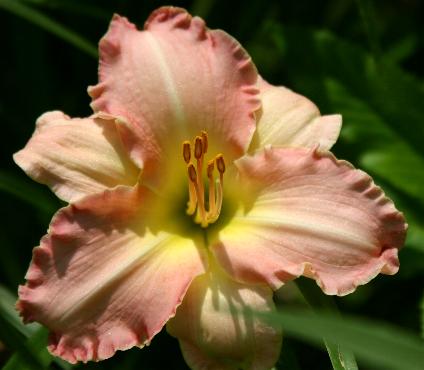
Today the pastels, especially the pinks were my favorites. Here are a few of them.
First is one that is barely pink, mostly just pink in the center and is called 'Salad Bowl'. It is a fairly large flower.

This next one is 'Shell Point', an older cultivar.

'Princess Powderpuff' is another oldie. So much of our garden is older cultivars that it is not surprising that most that I photograph were hybridized earlier than about 1985.

This is one of the newer ones called 'Louisiana Lovely'. It has thick, waxy petals and the best color.


'Lavendelle' is not strictly a pink, more of a lavender, but I'm including it because it is one of my favorites.


'CeeTee' is one I dug for a customer this morning. You can see why she chose it.


Last is 'Antique Rose', another with thick, waxy petals. I've always loved the shading on this one.


I've been taking a lot of pictures to update the website. I'll try to include some here every day as I'm working on it.
More heat tomorrow. We're certainly making up for last summer when it never, or only once hit 90 degrees. Fortunately the evenings have been cool so far. As crazy as the weather has been this year, we could have snow in July. Veggie garden is coming along. Still only lettuce and radishes to eat, but there are buds on the tomatoes, broccoli and cabbage look good and the cucumbers and sweet potatoes are growing. We've finished the onions. They never keep that well in this climate anyway.
Till tomorrow,
Jane


Friday, June 11, 2010

Deer Resistant Plants - Iris

All right. Too many long days of weeding and the brain is tired, so mostly a picture show today on Iris. Deer don't seem to bother them here, though with deer, you can never be absolutely positively sure they won't eat something.
This first one ia Iris albopurpurea 'Monstrosa'.


Next Iris virginica alba


Then Iris versicolor - pink form


Here's a tall bearded iris called 'Edith Wolford'.


Iris spuria 'Zamboanga' is definitely an unusual color.


Iris siberica 'Contrast in Styles'


Next, an iris that is a cross between 2 species. Iris pseudata 'Kinshiko'. I love this color, though it is easier to enjoy than to describe.


Iris pseudacorus 'Gold Pagoda'is a double form of Iris pseudacorus.


The Pacific Coast Hybrids are gorgeous, but here they are very short lived, 2 years at best. I tried to grow them, but they just don't seem to like our climate.


The miniature iris are cute and need really good drainage and lots of sun. This one is 'Black Cherry Delight'.


Next is Iris Louisiana 'Cherry Cup'

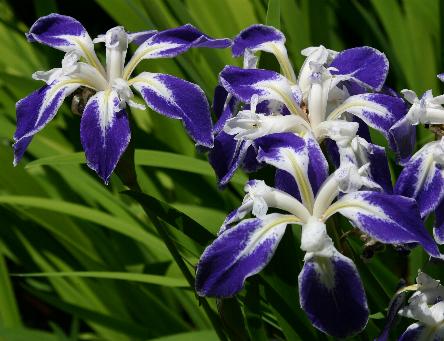
Iris laevigata 'Datusaga'.

Iris lactea, a small species.


Iris histrioides 'George' is an iris that bloom very early in the spring, even before most of the daffodils.

Iris graminea likes full sun and a sort of dry spot. The blooms are barely above the foliage, sort of like a flock of butterflies alighting on the leaves. This one blooms mid-May.


Iris fulva 'Red Dazzler' is a water iris. There is also a yellow form.

Iris ensata 'Wispy Clouds'. These used to be called Japanese Iris.
Iris cristata 'Blue Giant'. With the cristatas, the word giant is relative. These are small, ground cover type woodland iris.


I grow these Aril Iris (this one 'Burra Sahib') in the same gravel bed as the cactus. They need perfect drainage like they would find on the cliffs where they grow naturally.


Hope you enjoyed all of the photos. I think I'm done with the deer resistant stuff and will be off to 'what's blooming in the garden' for the next few posts.
Jane