


That's it for today. These are just a small number of all of the photos I took today. Tomorrow I'll try and post a bunch of peony pictures.
Jane
 Next is a more unusual one - a vining orchid that thrives in shade. Codonopsis lanceolata grows up a support to a height of about 10-15 feet - our still young plant makes it to about 8 right now. It circles the support (ours grows up a Japanese maple) without strangling it. I've found it to be a good idea to put a small fence, maybe a foot tall around the base because rabbits have found it tasty in the past. It didn't kill it, but it stopped growing for the year and waited for the next year to grow again and bloom, and the blooms are too special to miss.


 Last, but not least, is Calanthe discolor. This one is often listed as zones 6b-9, but we have no problem growing it here in 6a. The flowers have burgundy back petals and a white or pale pink center petal. It is native to woods in Japan. This one is smaller, only about 10 inches tall. Like the tricarinata, it may loose its leaves when the winter temperatures go below 10 degrees. This is quite easy to grow and makes a nice clump over time. While the tricarinata I planted about 8 years ago is still only one stem.
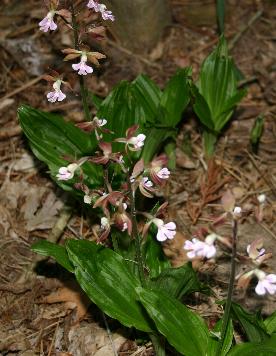 I do grow some tropical orchids in the house, but none will ever be as easy to grow and get to bloom as these lovelies from my outside garden.


 Until a couple of years ago, I had never heard of this plant. I'm not sure if it is a very large, woody stemmed perennial that dies to the ground or a small shrub that just isn't quite hardy enough to keep all it's branches during the winter. The common name of Shrub Mint doesn't help with the confusion. My established plants are at least 3 feet tall and as wide. This is the first one we got, simply Leucosceptrum stellipilum. We had ordered the variegated version and got this one by mistake. We kept it and just reordered the variegated one. There aren't that many things that grow in shade and also bloom in September - and that don't look like asters. The spikey blooms are pinkish purple on the plain leafed one and yellowish on the variegated one.
 And here is the variegated one, simply called Variegata. The pattern on the leaves is a combination of shades of green and a greenish/goldish/chartreusish color. They are just now leafing out and so usually avoid the worst of the late frosts. Its preferred location would be in light shade to part sun. Zones for it would be from 5 to 8. I've never seen them bothered by critters, with 4 legged or of the flying and biting varieties.
 When Asiatica Nursery was closing down last summer and fall, Barry had a lot of good bargains (and I'm a sucker for a good bargain on plants or yarn). The Leucosceptrum japonicum 'Golden Angel' was one of the things I bought. It took right off and is now about 2 feet tall and wide and wasn't bothered at all by last night's frost.
 The other one that I got was this Leucosceptrum stellipilum 'October Moon'. This photo doesn't do the colors justice. The centers of the leaves are a medium green and the edges a creamy chartreuse, but there are lots of small flashes of other colors in the edge and at the margin between the edge and the center. I think this is going to be spectacular when it gets big. It hasn't grown as much as the Golden Angel just yet, but I'm looking forward to a whole bush full of these lovely leaves.
 One of my spring favorites, Polygonatum odoratum 'Variegatum' or Variegated Solomon Seal. It is blooming in many places throughout the gardens and we will be giving quite a bit away this weeked in honor of Mothers' Day to moms and moms-to-be who visit the nursery on Sunday, May 8th. So if you're nearby, please stop to tour the gardens - and smell the lilacs.
 Quick post today since I'm supposed to be working on paperwork (ugh!). This is an oddity that I discovered in the garden this spring. Our Virginia Bluebells had seeded around a bit too much and so I decided to dig a few and transplant to a sort of too shady empty spot. When they bloomed this one was definitely pink. I know some seem to change color, but this one came out pink and stayed pink. I'll keep watching to see if it does the same thing next year or if it was only caused by the stress of being transplanted. Has anyone else ever had one bloom pink like this?
 A non plant post today - unless you consider the fact the this Common Water Snake (also sometimes known as Northern Water Snake) is living in the old bathtub where I keep my potted waterlilies. Common Watersnakes are one of the most common snakes in Ohio. It will live in just about any permanent body of water. I can attest to this as I have had them living in the smallest of our ponds. Actually, you don't get much smaller pond than a bathtub.
