Thursday, February 16, 2012

Oenothera biennis - Evening Primrose

I have always loved this plant. An elderly woman from my church gave me a start of a more cultivated form many years ago. Always so sunny and bright, just as she was. The version that grows in my fields and meadows is taller and more likely to seed about, but the yellow flowers are still cheery. As the name implies, this is a biennial. In its first year, it makes a rosette close to the ground, rather nondescript and pretty easily ignored. The second year it shoot up a tall bloomscape with lance shaped leaves and those pretty primrose yellow flowers which bloom from late spring through fall. This is an American native and prefers open fields or roadsides. It can tolerate some drought. Since the flowers open in the evening (and last until the next day) it is pollinated by moths, especially the Sphinx Moth. The blossoms are also attractive to bees, bumblebees and hummingbirds. In the fall you'll find Goldfinches eating the seeds.

As far as medicinal uses, the whole plant is gathered and dried and then a tea is made from a teaspoonful of the dried plant to a cup of hot water. It can be drunk hot or cold. It was said to be astringent and sedative, a good remedy for coughs or skin problems.

A pretty flower, maybe not one you'd want in your perennial border, except maybe at the back, though it's cultivated cousins are more than welcome in my garden.

Jane

Wednesday, February 1, 2012

Malva rotundifolia

Pretty flowers, nice leaves . . . horrible weed or useful medicinal plant? Actually, all of these apply. If it weren't such an invasive weed, I might even grow it in a perennial bed. Way back when, I learned this one by its common name, Cheeses. I always thought that was a funny name for a plant. And though I'm told that the name Cheeses refers to the seed pods, that doesn't make any more sense than the whole plant being called Cheeses. They are related to the Marsh Mallows and Hollyhocks. All seven types that grow in the U.S. have been brought in from Europe as none are native here.

The demulcent property is what makes this plant useful medicinally and which has since ancient times. Theophrastus mentioned it and Hippocrates gave specific instruction for its use. Pliny said "Whosoever shall take a spoonful of the mallows shall that day be free from all diseases that shall come to him." Depending on the species, either the large roots or the leaves are used to make an infusion. The resulting liquid, mixed with honey, is useful for loosening coughs and relieving sore throats. Grieve's Herbal suggests that a poultice made of any of the mallows will "remove obstinate inflammation ... The fresh leaves, steeped in hot water and applied to the affected parts as poultices, reduce inflammation, and bruised and rubbed upon any place stung by wasps or bees take away the pain, inflammation and swelling." That last use I'll have to try this summer since even though I'd like to have all of the Malva weeded out of the garden, there is always a bit left and the summer when I don't get stung by something is an unusual summer.

As I've been working my way through my book on medicinal plants, one thing has been pretty obvious. Although a number of them have been 'pretty flowers', a lot have been things that might better be classified as weeds. Pretty flowers, yes, but not the kind you want in your perennial border. It does make you think, though, about whether you should leave a few grow as medicinal plants instead of trying to obliterate every last one of the 'weeds'.

Jane

Saturday, January 28, 2012

Lycopodium

When I used to take walks in the woods as a child, I always loved this plant. Lycopodium was more commonly known to me as ground pine or ground cedar, though it is neither. It is in the clubmoss family and more closely related to ferns. One or more species can be found growing in most places in the world, usually in moist woods or boggy places. Lycopodium is low growing, not much more than 6-8 inches tall and is evergreen. It is the fruiting heads (you can see them in the picture) that bear the spores that are the lycopodium powder of medicine.

The powder has actually had many uses over the years, from a dusting powder for abraded surfaces, in microscopy as a standard for measuring the comparative sizes of substances (it would take 750 of then laid side by side to cover an inch), and even due to the extremely explosive nature of the spores, to produce lightning effects in the theater and in early flash photography. The spores are extremely water repellent, and if you were to dip your hand into the spore powder and then into water, you hand would not become wet.

The powder has been used both to kill lice and to improve bad wine and as a stabilizer in ice cream. One writer in an old herbal recommended it for 'female disorders', and another valued it as an aphrodisiac.

Of all of the uses, it was probably used most often as a dusting powder for eczema, and to prevent chafing in infants.

Not many of the plants I've written about have had such varied uses, both medicinal and practical - and this one you can buy on eBay for less than $12 for 25 grams, should you feel the need to experiment.
Next time - Malva rotundifolia, which here is more of a weed than a wildflower, but pretty just the same.
Jane

Thursday, January 19, 2012

Iris versicolor

We grow several different Iris versicolor cultivars here, the one above being 'Mint Fresh'. It is a rather small plant, as irises go, probably no more than 15 inches tall with a smallish bloom. The plain species is often taller than this cultivar. Size, though doesn't matter all that much, as this is such a lovely blossom.


Iris versicolor is commonly called Blue Flag, at least that's what I knew it as growing up. This one has variegated leaves, but the blossom is the same as the straight species. It is native to wet swampy places from Canada to Florida and west to Arkansas. We grow ours at the edges of ponds, or in low spots that tend to collect water, or even in mini-bogs that are just kiddie wading pools sunk in the ground and filled with a soil/peat moss mix to create a small swampy place to keep swamp loving plants happy. I know the people at K-Mart wondered what we might be going to do with 10 kiddie pools when we bought them.


One of my favorite versicolors is the photo above - 'John Wood'. We have a couple of clumps of this one growing under various conditions and all are doing well. The foliage (below) is also quite pretty in the spring when it first emerges.


As far a medicinal uses for the plant, it is the root or rhizome that is collected in the autumn and dried. Much care should be used if you consider using this plant for medicinal purposes since all parts of it are poisonous when fresh if taken internally. Still, it was considered useful as it was listed as an official drug for over a hundred years. It was used by the Native Americans who passed the knowledge of its usefulness on the the Colonists.

In addition to its uses as a diuretic, emetic, purgative and cathartic, the flowers yield an infusion that may be used to test for acids and alkalies in place of litmus paper. Some people have used the powdered roots in tooth powders.

So, a useful plant, though probably not one I'm going to use personally. Just being pretty in the garden is all that I require of my irises.

Jane

Tuesday, January 17, 2012

Impatiens capensis

Impatiens capensis - aka Jewelweed, Balsam, touch-me-not, snap weed. It grows wild here along creeks and in woods, usually in a quite shady spot. Along the creeks it can be 3 feet tall, in the woods, a little smaller. This is an annual that self seeds generously (I weed a good bit of it out, just leaving a nice clump here and there) and whose seeds are spread as the fruits explode, shooting the seeds for quite a distance. We loved making them explode when we were kids.


Jewelweed is listed as a medicinal plant because of its ability to releive the itch of poison ivy. Strange as it may seem, it often grows right alongside the plant for which it is an antidote. You pretty much just boil the plants in water to make a concentrated 'tea' that you then apply to the rash. I can vouch for the fact that this works. I haven't boiled down any myself, but our family doctor used to give it to patients as his 'secret poison ivy cure' back when my kids were very little. It is also reported to work as just the juice of the plant without boiling it down - you inadvertantly get into some poison ivy and you just crush some Jewelweed and rub it on the spot. Potter's Cyclopaedia says that it can also be boiled with lard to make a salve to relieve hemorrhoids, and that the raw juice of the plant will remove warts and corns and cure ringworm. In New England Rarities Discovered, and American herbal written in 1672, it was written that the colonists considered it a remedy for bruises.


It's a pretty plant that I've loved since I was a child, and despite its propensity to spread a bit too enthusiastically, I'll always allow it to grow here, especially as long as we still haven't managed to get rid of all of our poison ivy.


Impatiens pallida, the yellow flowered form, is also effective. At least around here, though, it seems less common. It is a larger plant and seems to have no problem growing in the sun, as we have several patches along the road that seem to do just fine.

This has to be one of the easiest medicinal plants there is since it grows often right next to the plant for which it is an antidote and requires no preparation for use, unless you want to have a supply on hand for winter, which is when I often get in trouble with poison ivy when I come in contact with the roots while clearing a new space for a garden. And yes, I'm ready for spring; enough winter already. And I've been planning several new garden beds and renovation for as soon as I can get out there and start working. The days are getting longer so it can't be too long yet, can it?

Jane


Monday, January 16, 2012

Hypericum perforatum (and some others)

Not the showy St. John's Wort, or the shrub ones, but a rather unassuming wildflower that grows here. It's a European native, but was brought to this country early and now can be found in many places, along roadsides and in fields. It even seems to grow in light shade. It's only a foot or so tall in my gardens and for years I didn't know what it was. I finally took the time to find out and was pleasantly surprised. It was too pretty to be classified as a weed and so it got to stay. It didn't spread around or get in the way. I'm glad I left it since it has turned out to be a pretty little thing growing in a daylily bed where it is a little out of place, buy lovely just the same.

It was used as an infusion for coughs and colds, or made into an ointment to be put on bruises, scratches or insect bites.

The plant has been historically associated with John the Baptist, hence it's common name. John the Baptist's birthday was at the summer solstice, an important day even in pre-Christian times, and some think that the bright yellow flowers were associated with that day. In addition to the medicinal uses, plants of this herb were hung over doorways and used in exorcisms.

Since I've started on Hypericums, I might as well show you some of the others that we grow.


Hypericum 'Blue Velvet is a small shrub with blue green leaves and the bright yellow flowers that are typical of the Hypericums. Ours grows in light shade where it gets a half day of sun and seems quite happy.


This one is 'Hidcoat Variegated', about which I know nothing, I hate to admit. Hank bought it (I think he'd buy anything as long as it was variegated) and it seems happy here so far.


And last, this is 'Tricolor', though in sun, there are surely more that 3 colors, the pink, white and several shades of green. This, I think, is a zone 7 plant, but because we like it so much, we go to great pains to keep several of them alive. Without a wrap or cover of burlap over the winter, they wouldn't make it until spring. It has been very slow growing and took many years to finally flower. Still, it seems worth the extra fussing we need to do for it in the fall to prepare it for winter. We've had it in the gardens for at least 15 years, so we must be doing something right.

Jane


Saturday, January 14, 2012

Hydrangea arborescens

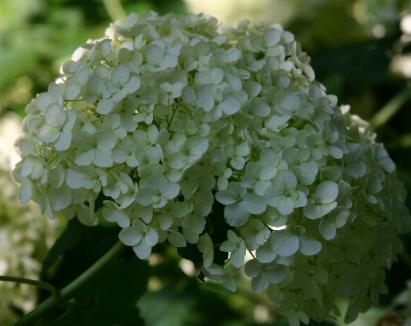
Such a lovely flower, Hydrangea 'Annabelle'. I just love these. The blooms last almost forever on the plant, and then if you cut them, they do last indoors all winter, and if you don't mind the increasingly brown, then very dark brown color, they will last in the house until they are just too dusty to deal with any more. Luckily, there is an abundant new crop of blossoms every year. I think the new pink flowered one will be just as lovely - if the deer will please stop eating the buds so I can enjoy its flowers.
I guess I was a bit surprised to find this hydrangea in a book on medicinal herbs. The species, as opposed to 'Annabelle', has smaller blooms but still is lovely. In its native range, from New York south to Florida and west to Missouri, it can be found growing in moist, rich woodlands, and I find that here in our zone 6ish garden it grows best in light shade where it gets sufficient moisture. I also have one growing at the base of a large mulberry tree where it gets much less moisture unless I remember to throw a 5 gallon bucket of water on it, and though it grows well, it is not nearly as large, nor are the flowers as large, as the one in better, moister soil.
The part of the plant that is used medicinally is the root, which has variously colored layers of root bark that can be peeled back, one layer at a time, and which gives it the sometimes used name of seven-bark. When a fresh root is dug, it is cut or crushed to be used in an unfusion, 1 teaspoon of root to a cup of boiling water, taken a mouthful at a time throughout the day. Although the book says that it was known that it wouldn't get rid of gall stones, it was taken to get rid of 'gravelly deposits'. It was also know to the Cherokee tribe for that purpose. It was thought that it would assist in removing brick dust deposits from the bladder and so was a popular remedy in areas with brick factories.

Even if you have no need or desire to use this shrub medicinally, it is still well worth growing for its beauth and ease of cultivation. It doesn't seem to have pest problems, doesn't mind a little drought, though in very dry spells it would like a drink every couple of days. Expect it to get about 4 feet tall and maybe 6 feet wide in time.