Monday, January 16, 2012

Hypericum perforatum (and some others)

Not the showy St. John's Wort, or the shrub ones, but a rather unassuming wildflower that grows here. It's a European native, but was brought to this country early and now can be found in many places, along roadsides and in fields. It even seems to grow in light shade. It's only a foot or so tall in my gardens and for years I didn't know what it was. I finally took the time to find out and was pleasantly surprised. It was too pretty to be classified as a weed and so it got to stay. It didn't spread around or get in the way. I'm glad I left it since it has turned out to be a pretty little thing growing in a daylily bed where it is a little out of place, buy lovely just the same.

It was used as an infusion for coughs and colds, or made into an ointment to be put on bruises, scratches or insect bites.

The plant has been historically associated with John the Baptist, hence it's common name. John the Baptist's birthday was at the summer solstice, an important day even in pre-Christian times, and some think that the bright yellow flowers were associated with that day. In addition to the medicinal uses, plants of this herb were hung over doorways and used in exorcisms.

Since I've started on Hypericums, I might as well show you some of the others that we grow.


Hypericum 'Blue Velvet is a small shrub with blue green leaves and the bright yellow flowers that are typical of the Hypericums. Ours grows in light shade where it gets a half day of sun and seems quite happy.


This one is 'Hidcoat Variegated', about which I know nothing, I hate to admit. Hank bought it (I think he'd buy anything as long as it was variegated) and it seems happy here so far.


And last, this is 'Tricolor', though in sun, there are surely more that 3 colors, the pink, white and several shades of green. This, I think, is a zone 7 plant, but because we like it so much, we go to great pains to keep several of them alive. Without a wrap or cover of burlap over the winter, they wouldn't make it until spring. It has been very slow growing and took many years to finally flower. Still, it seems worth the extra fussing we need to do for it in the fall to prepare it for winter. We've had it in the gardens for at least 15 years, so we must be doing something right.

Jane


Saturday, January 14, 2012

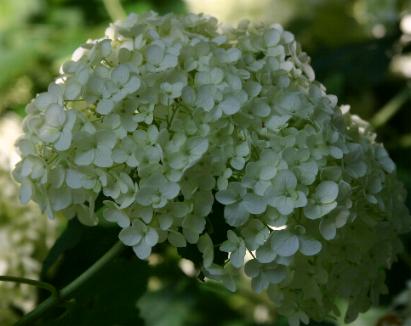
Hydrangea arborescens

Such a lovely flower, Hydrangea 'Annabelle'. I just love these. The blooms last almost forever on the plant, and then if you cut them, they do last indoors all winter, and if you don't mind the increasingly brown, then very dark brown color, they will last in the house until they are just too dusty to deal with any more. Luckily, there is an abundant new crop of blossoms every year. I think the new pink flowered one will be just as lovely - if the deer will please stop eating the buds so I can enjoy its flowers.
I guess I was a bit surprised to find this hydrangea in a book on medicinal herbs. The species, as opposed to 'Annabelle', has smaller blooms but still is lovely. In its native range, from New York south to Florida and west to Missouri, it can be found growing in moist, rich woodlands, and I find that here in our zone 6ish garden it grows best in light shade where it gets sufficient moisture. I also have one growing at the base of a large mulberry tree where it gets much less moisture unless I remember to throw a 5 gallon bucket of water on it, and though it grows well, it is not nearly as large, nor are the flowers as large, as the one in better, moister soil.
The part of the plant that is used medicinally is the root, which has variously colored layers of root bark that can be peeled back, one layer at a time, and which gives it the sometimes used name of seven-bark. When a fresh root is dug, it is cut or crushed to be used in an unfusion, 1 teaspoon of root to a cup of boiling water, taken a mouthful at a time throughout the day. Although the book says that it was known that it wouldn't get rid of gall stones, it was taken to get rid of 'gravelly deposits'. It was also know to the Cherokee tribe for that purpose. It was thought that it would assist in removing brick dust deposits from the bladder and so was a popular remedy in areas with brick factories.

Even if you have no need or desire to use this shrub medicinally, it is still well worth growing for its beauth and ease of cultivation. It doesn't seem to have pest problems, doesn't mind a little drought, though in very dry spells it would like a drink every couple of days. Expect it to get about 4 feet tall and maybe 6 feet wide in time.

Friday, January 13, 2012

What do you mean it's blooming in January???

Though I often tell people that there's something of interest in the gardens 12 months out of the years, that something isn't always a plant with flowers. We're still a bit away from even the snowdrops (Galanthus) and though the Hellebores have buds, none are what you could call open flowers yet at this point. This year, howeve, is different in many ways. We haven't had the horrible cold, and until today when we got about an inch, we hadn't had snow either. We've had more than enough rain, 2011 being one of the wettest years I can remember. And, we have blooms on Hamamelis (Witchhazel) and Lonicera (Honeysuckle). The one above is Hamamelis 'Rochester'. It is always one of the first to bloom, mostly owing to its position on a sunny, protected bank above a pond. It has become quite a large bush, allowing me to cut a generous quantity to bring into the house so that I can enjoy the wonderful fragrance without freezing my buns off sitting on a bench outside.


This Hamamelis is 'Girard's Purple'. It is also a large bush, but for some reason the scent isn't nearly as stong as that of 'Rochester', but I cut some anyway for the contrast in colors. There are years when the Witchhazels don't bloom until March, and then their bloom season is quite short because the flowers fade with the first warm/hot sunny day. With blooms starting in January, we should be able to enjoy them for a couple of months this year. Only a few are out so far, but all are quite well budded and so we should have lots of bloom soon.


The other shrubs that are blooming are a couple of the bush honeysuckles. The one above is Lonicera fragrantissima. It's probably about 6 feet tall and as wide. The blooms, though different in appearance, have that wonderful honeysuckle smell that reminds me of warm nights in early summer, when the fragrance wafts in the open windows on a light breeze. This can start blooming here any time between January and March. It will sucker a bit and can also tip root, so unless I need some extra plants, I try to prune it a bit after bloom, and dig any babies so that it doesn't crowd out its neighbors.


The other bush honeysuckle that is blooming right now is Lonicera purpusii. I originally bought this one because the catalog copy said that it bloomed in January, and anything that will bloom here in Ohio in January can have a place in my garden. This is the first year that it has ever done so. It is always nicely budded and looking like it will open those buds in January, but until this year, the buds never opened before the middle of March. Maybe it has finally adapted to our climate, or maybe it's just this weird weather year. Either way, I'm very happy that it's blooming right now.

Tomorrow I'll get back to the medicinal herb series, but I just had to share these wonderful plants today.

Jane

Wednesday, January 11, 2012

Helianthus annuus - Sunflowers

Common sunflowers, nothing fancy; the ones that come up in odd places in the garden where the chipmunks have buried seeds or the birds have dropped one. I have much more luck with critter planted sunflowers than with ones I plant myself. I think that the critters like to plant them, but also like to dig up ones that other people plant. Just my theory, but it would explain why theirs come up and mine don't often do so.
The common sunflower is a native plant almost everywhere in the United States.
In Jacobs' Index of Plants he writes "the leaves are astringent; the seeds are diuretic and yield a fixed oil ... The roots were used for snakebite and as a dye. The sunflower is used for coughs, pulmonary affections, dysentery, inflammation of the bladder and kidneys, and as an antimalarial."
An old recipe using sunflower seeds as a cough remedy: Boil 2 ounces of the seed in a quart of water (doesn't say if they are hulled or not). Boil down to a little less than a pint and strain. Add 6 ounces of gin and 6 ounces of sugar. To be taken three or four times daily in a dose of one to two teaspoonfuls for pulmonary affections and coughs. In the same way, seeds browned in the oven and then used to make the unfusion were said to provide relief for whooping cough.
The Journal of Lewis and Clark had an entry in July 1805 noting the use of sunflower seed to make bread and thicken soup.
After writing about a lot of medicinal plants where I felt the need to warn about these being old and questionable recipes, this is one that seems quite simple and probably safe. I have no idea, however, if it actually works, though I might be willing to give it a try.
As far as gardening here in the hollow - it's been a strange garden time. After one of the wettest years on record, we seem to be having a winter without horrible cold and, at least so far, no snow. Some is predicted in the next day or so, 2-6 inches, so it may actually start to look more like January here. We have witchhazels and winter honeysuckles blooming; daffodil foliage is up a couple of inches in many places. Luckily things bloom in the greenhouse this time of year so we don't get too crazy. Right now there is a lovely tiny gardenia covered with blooms that is making the whole place smell wonderful. In any event, in 2 months or so spring will be here with crocus and other early spring blooms starting. I'm not sure if I'm quite ready for the daily grind of weeding, but I'm sure ready for warmer weather and the outside being green instead of brown.
Jane


Tuesday, January 10, 2012

Glechoma

Nice vacation; time to get back to writing. I'm going to pick up in my herbal medicine book where I left off last time. The photo is of the variegated version of our ever-present pest, ground ivy, known also as gill-over-the-ground and creeping charlie.
I don't remember this growing at our house when I was growing up, but heck, there were parents and grandparents and kids, all gardening on a city lot, I don't remember weeds much at all. They wouldn't have had a chance. Where I do remember it is at my Aunt Nancy's farm, out in the country the other side of West Chester PA. She had a wonderful spring house, always so dark and cool, where they would chill the milk. Ground ivy grew around and in it (I'm sure she thought it was a nuisance) and for some reason I loved the smell of it when you walked on it and crushed the leaves. I still love the smell, even as I pull mountains of it out of my flower beds.
Although this seems to be everywhere, it is not native to North America, but was introduced by the early settlers. If it weren't such a weed, you might almost expect to find it sold in garden centers as a ground cover. This variegated version is sold by a number of nurseries and though sometimes a bit tricky to get started, I think it can be just as much of a nuisance as it's plainer cousin once established.
One of the original uses for the plant was to impart the desired bitter flavor to beer, to prevent it from turning sour, and to clear it. This use for the plant ended about 400 years ago when they discovered that hops would do the same thing, and I assume would do it better since that has been used ever since.
Other uses for the plant are for coughs accompanied by phlegm. It is used either fresh or dried, a teaspoonful of leaves to a cup of boiling water, a cupful of more a day. It has also been suggested that sniffing the crushed leaves will cure a headache.
Grieve's Herbal suggests that because of its astringent properties, it is useful for bruises and black eyes.
So next time you're weeding the garden and get the urge to pull out all of the ground ivy, maybe you might think twice about leaving a little patch . . . just in case . . . for medicinal purposes.

Tomorrow - hamamelis (witchhazel)

Jane

Tuesday, September 13, 2011

Fall Blooming Perennials, Part 1

I had originally thought I would make one post on Fall blooming perennials, but once I started thinking and writing, I realized that I would need 2 posts to get them all in and not be way too long, so here is part one. For my definition of Fall blooming, I have chosen things that don't start blooming until after Labor Day. There are certainly other things blooming in the garden, daylilies, hibiscus or various sorts, yarrows, hostas and others, but they have all been blooming for awhile or are reblooming. All of the plants I'm going to write about are just now starting to bloom, or in some cases, haven't even started their bloom yet for this season.
Blue Asters seem to pretty much say Fall for me. This one is Aster patens 'Slatey Blue'. This is tryly a late blooming plant that fortunately doesn't mind a bit of frost. This is a photo I took last year since it is only now beginning to bud. It's a large thing, 2 or 3 feet tall and at least as wide. At its peak bloom, there are hundreds, maybe thousands or blooms open at once. It makes an excellent cut flower for fall bouquets; excellent with some Golden Rod collected along the side of my road. Likes sun, but generally isn't very fussy about where it lives.


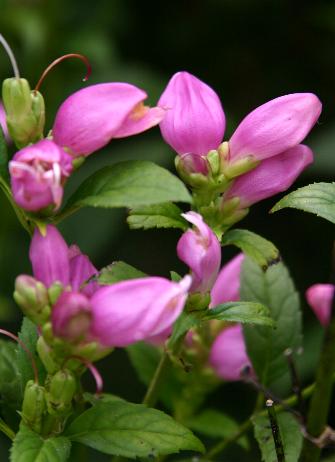
Chelone obliqua just doesn't look to me like a fall bloomer; maybe it's the pink bloom which doesn't seem to me to be a fall color. This one likes lite shade and doesn't seem to mind a slightly damp spot. About 2 feet tall or a little more and a slowly spreading clump.


Colchicum 'Violet Wonder' is sort of a magical plant. Like those Neked Ladies that were blooming in August, Colchicums put up their leaves in the spring. Dark green and heavy, straplike and produced in large numbers, they leave you anticipating wonderful flowers - which don't appear. The leaves fade away and you kind of forget about them. Then one September day, you go out, and where there was nothing yesterday, there is now this explosion of color and very un-Autumn-like blossoms. Some people call these Autumn Crocus, but they're not, they're Colchicums. Sun is best, but I've had some in light shade that also did fine. Those that ended up in heavy shade after trees got big around them had to be moved to a sunnier spot to keep blooming.


There are actually fall crocus and this one is named 'Kotschyanus' - a lovely blue with darker blue striping. This is another photo from last year since these have not yet come up this year. I just planted some more of these today since they are such a welcome sight this time of year. Right now, by the way, is the time to plant both fall crocus and colchicums.


Impatiens Omeiana makes a lovely show of foliage all summer, 12-18 inches tall, lightly patterned foliage in a clump that increases in size every year. This is a shade plant, though it seems to like some dappled sun, especially morning sun. Bright sun will leave you with a wilting and decidedly unhappy looking plant. I noticed this past weekend that it was starting to bud, so blooms should be out in a few days. They don't show it in this photo all that well, but they blossoms always remind me of goldfish hanging there. Even though this is an Impatiens, it is perfectly hardy here in zone 6 and probably good in zone 5 with some protection.


Kalimeris yomena 'Fuji' is a nice variegated plant all season. Dappled sun to light shade work equally well. Full sun doesn't seem to suit quite so much, though some sun will keep the variegation bright. It's easy to divide and I've divided mine several times so that I can spread the fall blooming around the garden. Only about a foot tall, it spreads nicely without being a pest and doesn't seem to seed around, at least it hasn't in the dozen or so years it has lived here.


The Kalimeris blooms are a nice pale blue aster-like flower and last for several weeks once they start. They make good cut flowers.


Leucoseptrum stellipilum also likes lite shade. This version (I grow 4 different ones) has a plain leaf and pink flower spikes. These clumps can get to be 3 feet tall and as wide. They seem to like a moist place and are well liked by honey bees.


This variegated Leucoseptrum likes the same conditions and has yellow/cream flower spikes. I have also gotten, last summer, one with green leaves with a gold edge, and one with gold leaves.

So that's it for the first installment of Fall Bloomers. All of these are quite hardy here in zone 6, though if you are a different zone, you should check on the hardiness for your zone. As far as I know, all are readily available.

Jane

Wednesday, August 31, 2011

Changes

Pictured here - Hibiscus 'Flyer'. Fall is coming (quickly) and this is definitely a harbinger of things to come. If you need a plant that will make a statement in the garden, this is it. Bright red flowers, some a foot across, on plants that can reach 10 feet tall. Definitely something you can see from across the yard if not from down the street.
Actually, I wasn't going to write about Hibiscus today, but rather about changes to the blog. As I've gotten older and the garden has gotten bigger (the problem with having pretty unlimited space in which to plant), my time for sitting at the computer has shrunk, so I'm going to try a monthly newsletter sort of thing with what's blooming now, maintenance type things I'm doing in the garden, new plants we've added, bugs we're fighting with and much more. This won't, of course, keep me from posting more often as things occur to me or when I have pictures to share, but maybe I can stop feeling so guilty about not posting so frequently if I can keep telling myself that I promised one newsy post a month. Maybe it's just the time of year when the garden gets dry and the weeds finally get totally out of control in spots and I find myself struggling to keep everything looking its best (and losing miserably in the effort). Of course, hosta beds and shade gardens look good except where the deer have munched, so if you're planning a visit, there will be plenty to enjoy.
So, shortly after the Labor Day holiday, look for my first monthly newsletter, or follow my weekly (or more often) updates on Facebook, always with a picture of something that's blooming. And while you're on Facebook, why don't you 'friend' us.
Jane